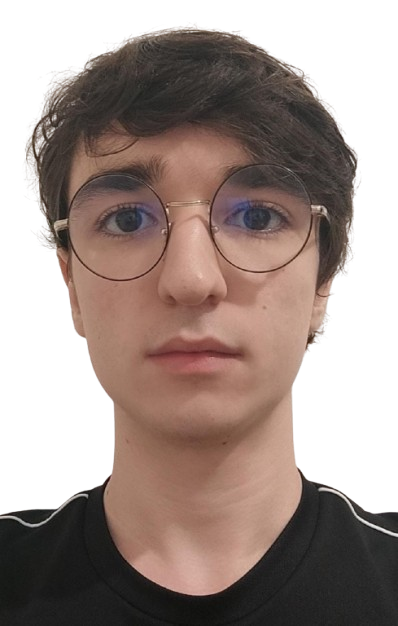
Hello, I'm Hugo Antunes

Undergraduate Student

About Me

Hugo Antunes

I am a Computer Engineering student at Federal University of Rio de Janeiro (UFRJ), currently in the fifth semester. At GTA, I am part of the GT-CampusEdge project and Tranship, being supervised by Professor Pedro Henrique Cruz Caminha, Rodrigo de Souza Couto and Luís Henrique Maciel Kosmalski Costa.

Previously, I was a student at the Celso Suckow da Fonseca Federal Center for Technological Education (CEFET-RJ) in the building course, graduated in 2022.

When I'm not studying, you can find me playing videogames, watching movies, or watching football. I believe in continuous learning and pushing the boundaries of what's possible with technology.

Download Resume

My Experience

Undergraduate Research

Grupo de Teleinformática e Automação

2023 - Present

Development of an application to reduce processing in object detection. Image labeling for training Neural Networks. Publication articles.

Technical Intern

CEDAE/RJ

2021 - 2022

Assisted in the construction of floor plans, topographical surveys and technical visits to old company buildings.

Published Articles

Frame Similarity Assessment on the Edge for Improved Object Detection

Real-time object detection is a recurring challenge in the field of computer vision. It is an important task for many real-time applications, such as trespassing detection or autonomous driving. However, real-time processing requires high computational power, increasing the latency of object detection. Delays can be a critical problem for constrained real-time applications running on the edge, such as advanced driving assistance. Therefore, this work proposes a method, called Lightweight Pixel Difference Accumulation (LWPDA), to reduce the processing effort by frames which are similar to recently processed ones.

Read More

Frame Dropping for Reducing Delay in Object Detection in Videos

Real-time object detection is a common challenge in different contexts, such as in autonomous cars and surveillance cameras. However, the processing of videos in real-time needs a high computational power, and this requirement causes the occurrence of delays. Some of these applications may be sensitive to delays, causing their operation impaired. In this way, this paper proposes a comparison between sequential frames using the RGB values of each pixel. Those frames deemed similar will not be processed, which decrease the processing time. The experiments that were done throughout this work, lead us to the conclusion that there's a certain processing time reduction of 41,5% with the loss of precision inferior to 13%.

Read More

Skills & Expertise

Python

Computer Vision

Git

Programming

Get In Touch

Feel free to reach out if you have a question, or just want to connect.